

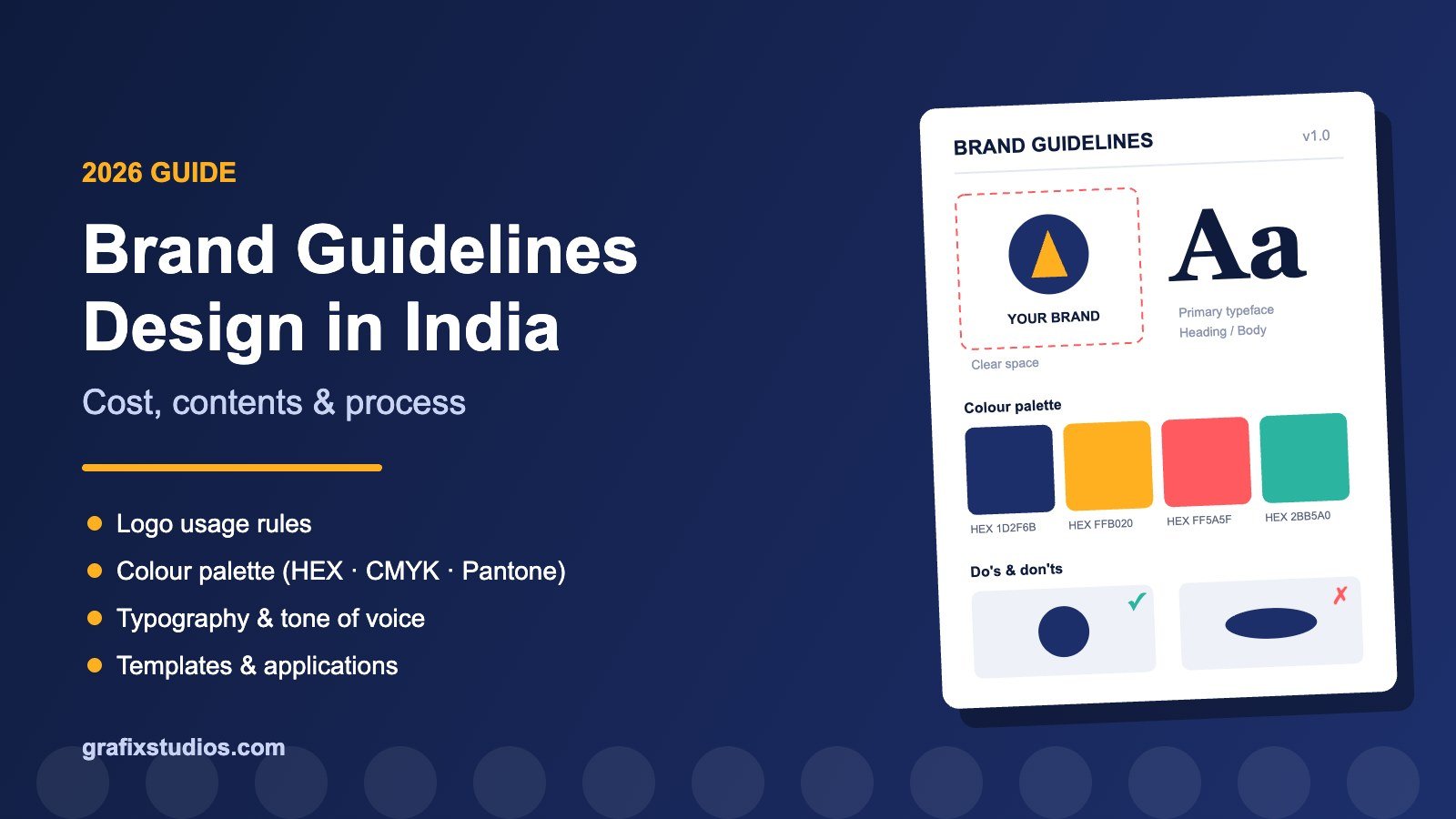
Brand guidelines design in India typically costs ₹8,000–₹25,000 for a compact brand sheet, ₹25,000–₹75,000 for a full brand guidelines document, and ₹75,000 upwards for a detailed brand book with templates, depending on how many touchpoints it covers. A good brand guidelines document tells anyone who works on your brand (an in-house designer, a printer, a freelancer, a social media agency) exactly how your logo, colours, fonts, imagery and tone of voice should be used. This guide explains what goes into one, what drives the price and how to brief a designer so you get a document your team will actually use.
What is a brand guidelines document?
Brand guidelines (also called a brand style guide, brand manual or brand book) are a rulebook for your visual and verbal identity. Your logo is one asset; guidelines explain how that asset and everything around it should behave on a visiting card, a hoarding, an Instagram post, a product box or a website.
Without guidelines, every new vendor reinvents your brand a little. The logo gets stretched, the blue turns slightly purple at the printer, a different font creeps into the brochure, and within a year your brand looks like three different companies. If you are still unclear on where the logo ends and the brand begins, our post on logo vs brand identity covers that difference in detail.
What should brand guidelines include?
The contents depend on the size of your business, but a solid document for an Indian SME or startup usually covers the following.
1. Brand foundation
- A short brand story, mission and positioning statement
- Who the brand speaks to (primary customer profile)
- Three to five brand personality traits, for example “warm, expert, no-nonsense”
2. Logo usage
- Primary logo, secondary/stacked version and icon or favicon version
- Minimum clear space and minimum size for print and screen
- Approved colour versions: full colour, single colour, white on dark backgrounds
- Clear “don’ts” with visual examples: no stretching, no drop shadows, no recolouring, no placing on busy photos
3. Colour palette
- Primary and secondary colours with HEX and RGB values for digital use
- CMYK values for offset printing and Pantone references where you need exact matching (packaging, signage, uniforms)
- Usage ratios, for example how much of a layout should be your primary colour versus neutrals
4. Typography
- Heading and body typefaces, with weights and sizes for common uses
- Fallback fonts for Word, PowerPoint and email, because most teams will not have your premium font installed
- If you communicate in Hindi or another Indian language, a matching Devanagari or regional typeface
5. Imagery, icons and graphic elements
- Photography style: lighting, mood, real people versus stock, product shot rules
- Icon style (line or filled, stroke weight) and any patterns or shapes that belong to the brand
6. Tone of voice
- How the brand writes: formal or conversational, English, Hinglish or bilingual
- Words and phrases you use, and ones you avoid
- Sample captions, headlines and WhatsApp replies
7. Applications and templates
- Visiting cards, letterhead, envelope and email signature
- Social media post and story templates
- Presentation template, invoice/quotation layout
- Signage, packaging, uniforms or vehicle branding where relevant
Brand guidelines design cost in India (2026)
Prices vary widely between freelancers, small studios and large agencies. The ranges below are typical market ranges, not fixed quotes; your final cost depends on scope, the number of applications and whether the identity already exists.
Basic brand sheet: typically ₹8,000–₹25,000
A one- to four-page reference covering logo versions, colour codes, fonts and a few do’s and don’ts. Suitable for a new shop, clinic, café or a startup that needs consistency quickly and will expand the document later.
Standard brand guidelines: typically ₹25,000–₹75,000
A 15–35 page PDF covering the full brand foundation, logo system, colour, typography, imagery, tone of voice and core stationery and social media applications. This is the right level for most growing SMEs, D2C brands and service businesses that work with more than one vendor.
Comprehensive brand book: typically ₹75,000–₹2,50,000+
A large document with editable templates (Canva, Figma, PowerPoint, Illustrator), packaging rules, signage and interior specifications, multiple sub-brands and sometimes a web-based version. Usually needed by multi-location businesses, hospitals, schools, real-estate developers and FMCG brands.
What pushes the price up or down
- Existing identity vs new identity: documenting an existing logo is cheaper than designing the identity and the guidelines together.
- Number of touchpoints: each additional application (packaging, signage, vehicle, uniform) adds design and documentation time.
- Editable templates: working Canva or PowerPoint templates take far longer than static mock-ups, but save money every month afterwards.
- Languages: bilingual typography and tone rules add work.
- Strategy depth: workshops, customer interviews and competitor audits increase cost but make the document more useful.
If you are budgeting for the logo as well, see our breakdown of logo design cost in India.
Do you actually need brand guidelines?
You probably do if any of these are true:
- More than one person or agency creates material for your brand
- You are opening a second location, launching a new product line or franchising
- Printers keep getting your colours wrong
- Your social media, packaging and website do not look like the same company
- You are raising funds, entering modern retail or pitching to corporate clients, where a consistent brand signals professionalism
If you are a one-person business that has just launched, a basic brand sheet is enough for now. Upgrade when you start hiring or outsourcing design.
The brand guidelines design process: step by step
- Brand audit: collect every existing asset (logo files, visiting cards, posts, packaging, signage) and note the inconsistencies.
- Discovery: a short questionnaire or call on audience, competitors, positioning and personality.
- Identity refinement: fix or finalise the logo system, colour palette and typography. Small corrections here, like a cleaner icon version, save years of trouble.
- Rules and examples: write clear, visual rules. Every “don’t” should have a picture.
- Applications: design the real-world items your team uses most often, ideally as editable templates.
- Review and print test: check colours on actual print proofs and on mobile screens before finalising.
- Handover: a PDF of the guidelines plus an organised asset folder (AI, EPS, SVG, PNG, PDF) with clear file names.
Quick checklist before you sign off
- Logo files in vector (AI/EPS/SVG) and transparent PNG, in every colour version
- HEX, RGB, CMYK and Pantone values that have been tested on real print
- Font licences or free alternatives clearly noted
- At least five editable templates your team will use weekly
- Version number and date on the document, so updates are easy to track
- One named person in your team who “owns” the brand and approves new material
How Grafix Studios approaches brand guidelines
We are a design and branding studio based in Ranchi, working with businesses across India. When we build brand guidelines, our priority is practicality over thickness. A 60-page brand book that nobody opens is less useful than a focused 20-page guide plus templates your staff use every day.
In practice, that means we usually:
- Start by auditing what you already have, so we keep the equity in your existing brand instead of starting from zero
- Specify colours for both screen and print, because many Indian printers work in CMYK while your Instagram is in RGB
- Include ready-to-use social media, visiting card and presentation templates, not just mock-ups
- Write tone-of-voice notes in the language mix your customers actually use
- Deliver organised source files so you are never dependent on us to find your logo again
You can see examples of identity work in our portfolio. If you need ongoing designs that follow your guidelines every month, our monthly design membership plan is built for exactly that.
Frequently asked questions
How long does it take to create brand guidelines?
A basic brand sheet usually takes 3–7 working days. A standard guidelines document typically takes 2–4 weeks, and a comprehensive brand book with templates can take 4–8 weeks, mostly depending on how quickly feedback comes back.
Can brand guidelines be made for an existing logo?
Yes. Most of our guidelines projects start with an existing logo. We clean up the files, fix any technical issues and then document the rules around it.
What format will I receive the brand guidelines in?
Usually a high-resolution PDF, plus a folder of logo and asset files. Editable templates can be supplied in Canva, Figma, PowerPoint or Adobe formats, depending on what your team uses.
What is the difference between a brand style guide and a brand book?
The terms are often used interchangeably. Generally, a style guide focuses on visual rules (logo, colour, type), while a brand book also covers strategy, story and tone of voice.
How often should brand guidelines be updated?
Review them once a year, or whenever you add a new product, location or channel. Small updates are normal; a well-built document is designed to grow.
Is a brand guidelines document worth it for a small business?
For most small businesses, yes, at least in its basic form. It prevents costly reprints, speeds up work with every new vendor and makes a small brand look established.
Get your brand guidelines designed
If your brand looks different everywhere it appears, a clear set of guidelines is one of the most cost-effective fixes. WhatsApp or call Grafix Studios on +91 9031525882, or share your requirements through our contact page, and we will suggest the right scope for your business and budget.